
June 8, 2026
How quickly can your company adapt when something stops working so that patients don't feel it?
I stopped by my local coffee shop this morning after the gym. And when I say local, this is the type of place where the baristas not only know my name, but also my order… where I run into neighborhood friends… and start random conversations on weekend mornings.
As I was walking down the block, I could tell something was different, because several people were gathered outside of the shop. It turns out, the HVAC was broken. But they had immediately adapted. One barista was behind the espresso machine, making the drinks. One walking back and forth to the door to deliver the orders. One by the door to take orders. And three giant fans blasting.
Of course, they were frazzled. But they'd taken it in stride and kept everything moving. Despite all of this going on, the person who took my order asked me "the usual?" … the barista making my drink mouthed "extra hot or iced?" to me from behind the espresso machine … and the one who handed it to me told me she read my Substack over the weekend.
My coffee experience this morning was different. But it was still great! Chatting with other patrons, we all appreciated that we were still walking away with our coffees.
Healthcare is undoubtedly about health. But it is also about care. The human element matters.
Consider wait times. Research shows patients forgive a long wait when they're kept updated by the front desk, see their doctor without feeling rushed, get their questions answered, and feel like their experience matters. After a long wait, the last thing anyone wants is a rushed appointment.
But the everyday wait feels routine. Sometimes, the system fully breaks down. And then, the appointment that a patient may have built their entire day around, taking time off work, scheduling childcare, managing the stress of the news they may get… gets cancelled an hour before. That's the healthcare version of walking up to a coffee shop with a broken HVAC and a swarm of people on the sidewalk.
As an industry, we're creating all sorts of new technology and infrastructure. But when something breaks, the patient isn't grading your tech. They're focused on people. Did they get an automated text at 7am and no follow-up? Or did a human call them? Did whoever called them rebook them right there on the phone or hand them another phone number to chase? Did whoever called acknowledge that this was disruptive?
Breakdowns happen. The question is whether the patient feels like an inconvenience or like people were genuinely scrambling to help.
Hopefully, the coffee shop gets its HVAC fixed soon. I'm glad they adapted, because my coffee tasted as great as it did yesterday. The baristas definitely made me feel like my coffee experience mattered to them.
Because when something disruptive happens, what patients remember isn't that something broke. They remember whether you made them feel like a person while you were fixing it.

May 20, 2026
Ideas are wonderful.
Someone pitches something in the hallway? Awesome. A speaker or podcaster says something that sparks a new thought? Great. A random comment in a meeting sends your brain somewhere new? Cool. You go on a walk with someone and come back with your thoughts swirling? Excellent.
I love all of it.
But the thing is… not every idea deserves your energy. The best leaders I know are great learners AND they have excellent filters. They can hear ideas and decide which ideas to process and which ones to hear and dismiss.
In healthcare especially, ideas get tossed around constantly. I've painfully watched leaders get advice from so many different directions that they spin their wheels pursuing all of it. What a waste of energy, investment, and money!
So what is a great filter actually made of? I'm imagining a coffee filter, some are far better than others.
After years of partnering with and advising healthcare leaders, I think a great filter comes down to the following:
First of all, is it a good idea? Sometimes, I've seen leaders follow an idea just because it exists… without stopping to think about whether they agree with it.
▫️ Does the idea fit with your north star? Every great leader has a strong point of view on where they're going. If the idea doesn't add to that strategic direction, it's a distraction, even if it's an interesting distraction.
▫️ Does it fit with your values? Your north star tells you where you're going and your values help shape your strategy on how you'll get there. If the idea doesn't align with your values, then the rest of the idea shouldn't filter through.
▫️ Is it relevant right now? Timing matters. The right idea at the wrong moment is still a wrong idea.
▫️ Does it make sense given what's actually happening at your company today? Bandwidth, resources, team capacity, etc. Context is everything. An idea that works for another company may be a distraction for you.
Curiosity makes you hear the new idea. A filter is what needs to happen once you've heard it.
April 30, 2026
I am by nature a bit of a know-it-all. And I am extremely curious. I know both of these things about myself… Lucky me!
I was that annoying kid in your elementary school class who was definitely the teacher's pet, raising my hand first to answer any question, because of course, I knew the answer!
Because I did, since I coupled my know-it-all-ness with extreme curiosity. I wanted to learn everything so that I could actually know-it-all. I am that can't-stop-asking-questions-until-I-know-everything kind of person.
As Martha Wofford succinctly put it during the WBL (Women Business Leaders of the US Health Care Industry Foundation) Summit last week, "how do you go from being a know-it-all to being a learn-it-all?"
The thing is that being a know-it-all isn't a great leadership trait. It is usually coupled with confidence, which is of course vital in leadership. But great leaders also know that they don't know everything. That it's important to be a sponge to learn more.
So I lean into that trait, the extreme curiosity. Diving into things curiosity-first also forces you to listen, and really hear what people are saying.
Excellent leaders couple their confidence in what they know with a real awareness that they also need to keep learning.
In healthcare, there is always something changing. New treatment protocols, new technology, new regulatory laws, new reimbursement changes. Continuously learning is critical.
Because if you're not that sponge, you are stagnant. And in this world that moves fast, stagnancy doesn’t work.
But for these excellent leaders, learning doesn't mean that they act on everything that they learn.
The filter that they run new information through is just as critical as learning it in the first place!
March 9, 2026
Universal Health Services (NYSE: UHS) announced today that it will acquire Talkspace (NASDAQ: TALK) for $5.25 per share (~$835 million), with closing expected in Q3 2026.
UHS has long dominated brick-and-mortar behavioral health, with a footprint of 29 acute care hospitals, 346 inpatient behavioral health facilities, and 168 outpatient and ambulatory facilities across 40 states.
Talkspace's virtual mental health platform brings a network of 6,000 licensed clinicians, nationwide coverage, and roughly 1.6 million annual virtual visits.
What does this transaction mean? UHS is expanding its continuum of care ... inpatient psych through virtual therapy. The major brick-and-mortar operator is making a decisive investment in digital health. UHS' outpatient strategic priority now includes virtual care, shifting digital health up the continuum from supplemental to core.
What does it mean for other behavioral health companies? Differentiation is essential. It could include:
▫️ Specialty clinical expertise (women's mental health, OCD, eating disorders, SUD, trauma, etc.)
▫️ Depth of care quality in complex populations (such as SMI)
▫️ Geographic strength or dominance in a specific area
▫️ Population-specific models (youth, seniors, Medicaid-focused, culturally-specific, post-partum & maternal care)
Clinician recruitment, credentialing timelines, and cash-flow constraints during ramp-up are already challenges for behavioral health companies. A combined UHS-Talkspace will only heighten competition for clinicians and patient acquisition.
Demand in behavioral health continues to be strong. But the companies that will thrive, in a sustainable way, are those that can
1️⃣ Recruit and retain clinicians in a more competitive environment,
2️⃣ Articulate a clear, differentiated value proposition, and
3️⃣ Build a sustainable model that balances access, clinical quality, and financial discipline.
Now is the time to refine strategy and clarify where you can lead in an increasingly integrated, hybrid behavioral health market.
February 25, 2026
“𝗡𝗼 𝗠𝗮𝗿𝗴𝗶𝗻, 𝗡𝗼 𝗠𝗶𝘀𝘀𝗶𝗼𝗻”
I started my career in healthcare (yikes, 20 years ago now!) working as financial and strategic advisor to hospitals, health systems, and academic medical centers. This phrase was everywhere.
It's most often attributed to Sister Irene Kraus of the Daughters of Charity Health System (in the 70s or 80s), who reminded her colleagues that without producing a margin each year, there would be no mission left to protect.
While there are haves and have nots among health systems, this tension of “no margin, no mission” is a daily reality for many. Strategy is often guided by it. Tough decisions are justified by it. Protect the margin today in service of the mission tomorrow.
In healthcare services, the inverse is also true.
𝗡𝗼 𝗠𝗶𝘀𝘀𝗶𝗼𝗻, 𝗡𝗼 𝗠𝗮𝗿𝗴𝗶𝗻.
At least, not a sustainable one!
We've all seen companies falter on this, chasing short-term margins at the expense of long-term mission, long-term growth, and ultimately long-term margins. They scale quickly, drift from their clinical purpose, and then watch patients move to competitors who deliver a more trusted experience.
Mission drift can be expensive.
So, if "no margin, no mission" guides financial discipline, then "no mission, no margin" must guide strategy. As a company grows, it's worth asking:
🔹What patient experience are we actually delivering and does it reflect our clinical mission?
🔹How are we building and protecting patient trust?
🔹Are our providers aligned with the mission we claim?
🔹Does our marketing match what operations can reliably deliver?
🔹As we scale, are we scaling our clinical mission or diluting it?
Durable patient trust, a consistent patient experience, aligned providers, and long-term margins all flow from the same source: a mission that is real, operationalized, and protected as the company grows

February 13, 2026
I've been working with a CEO who's presenting a major pivot to his board. When he sent me the first draft, my first comment back was: "Formatting matters!"
He called me right away, chuckling that this was my first comment.
𝗙𝗼𝗿𝗺𝗮𝘁𝘁𝗶𝗻𝗴 𝗱𝗼𝗲𝘀 𝗺𝗮𝘁𝘁𝗲𝗿!
It's how you show the reader/viewer where to look, what's important, and what the story actually is.
Every week, I see brilliant leaders bury their own insights behind walls of text or dense data. The content is real but the format forces the audience to fight their way to the point.
In middle school, we had a required class called something like "basic computer skills." We learned bold, italics, fonts, colors, and backgrounds. I probably over-formatted everything for years after that! But the muscle memory stuck.
Then, I started my career as an investment banker. If you know any former bankers, you know that when the spreadsheet is open, we immediately format the whole thing! We can't help it.
Seriously, though… Formatting (well, good formatting) helps:
▫️ 𝗘𝘅𝗽𝗹𝗮𝗶𝗻𝘀 𝗵𝗶𝗲𝗿𝗮𝗿𝗰𝗵𝘆: your audience can easily distinguish between primary, secondary, and optional.
▫️ 𝗥𝗲𝗱𝘂𝗰𝗲𝘀 𝗳𝗿𝗶𝗰𝘁𝗶𝗼𝗻: they can quickly read the main point without frustration.
▫️ 𝗕𝘂𝗶𝗹𝗱𝘀 𝘁𝗿𝘂𝘀𝘁: clean structure signals clean thought behind the strategy.
If you really want your board, your advisors, or your management team to truly understand you, don't make them fight the page.
𝗙𝗼𝗿𝗺𝗮𝘁 𝗶𝘁 𝗳𝗼𝗿 𝘁𝗵𝗲𝗺!
February 8, 2026
I've spent all week thinking about patient trust.
Every healthcare CEO wants to build patient trust quickly. But that patient trust is fragile. You can break it in a moment. Building strong, durable, sustainable patient trust takes time.
Think about the penny doubling metaphor. If you start with a penny, and double it every day, after one week, you'd have 64 cents. After two weeks, you'd have under a hundred dollars. After three weeks, a little over ten thousand. And after week four, over a million.
Patient trust doesn't grow linearly, it compounds. Compounding is hard to see at the beginning.
Now, patient trust doesn't usually double every day. But the point is, when you build that durable trust, it doesn't seem like trust has been built after week one or two or even three… but that's the foundation that's required to get to the result at the end of week four! (Or month one, month two, etc.)
A lot of healthcare companies get impatient at the beginning. The healthcare companies that are building durable patient trust, they are tracking those pennies in the first few weeks.
🔹Did the patient feel heard?
🔹Was the patient experience delivered the same as what was marketed?
🔹Did the care match expectations?
🔹Was there appropriate follow-up so that the patient felt supported before and after the appointment?
🔹Was there as little patient friction as possible?
These early "pennies" are the foundation that's required to build that patient trust over time. When they start compounding, that's when durable patient trust is building.
And once you build it? Treat it like gold.
January 27, 2026
In healthcare, your board is a critical design choice, one that determines whether the company can actually deliver on its healthcare mission AND focus on long-term financial sustainability.
Last week, I spoke with the CEO of a healthcare company with hundreds of millions of revenue, backed by a cap table full of hefty names. And yet, he couldn't get his board aligned on a strategic direction he believed was essential for the company's vision and future.
When I asked why a particular director was there, he said, "Oh, my investor insisted. Now I'm stuck with them." From there, the company added more seats for "visibility." And now those haphazard choices are creating friction for the company at a key moment when building consensus and alignment is critical.
Building a board for a healthcare company isn't an administrative task. Boards that are assembled reactively to appease, check a box, add prestige, etc. end up slowing the progress that they were meant to support.
Designing a board is a consequential strategic decision that shapes the future of the company.
Designing a strong, high-functioning board in healthcare includes a few non-negotiables:
▫️ Perspectives that fill in blind spots. Not cheerleaders or cynics, but rather individuals that elevate the scope and quality of decision-making.
▫️ Judgement under pressure. Healthcare is volatile, regulations change, markets shift, and companies hit stumbling blocks. Individuals who can stay clear-headed during the storms are critical.
▫️ Long-term lens. Individuals who see around corners, understand long-term systemic risks, and govern the company toward long-term sustainability.
▫️ Alignment with mission. Individuals who share the company's values, are aligned with the culture, and have the ability to smooth friction instead of creating it.
When building a board, define the company's north star, its mission. Figure out who has the wisdom, knowledge, and steadiness to help govern toward that north star.
Designing a strong board is a true test of leadership. A well-designed board is a force-multiplier.
It requires clarity, discipline, and the courage to choose alignment over convenience or cheerleaders.
January 19, 2026
Great healthcare leaders are also great consensus builders. When they have an idea, they bring people along with them on the ride.
They build consensus and alignment with different stakeholders, with patients, providers, the operations team, the marketing team, their Board, their investors.
They help these different groups understand why the initiative is important.
Consensus building is a critical foundational component to strong execution. When stakeholders feel bought in, they want the initiative to work.
Great healthcare leaders are also great listeners. They start with the idea and allow that idea to evolve as they gather feedback on that idea as they build consensus around it.
The initiative that moves forward is rarely the same as what they started with and that evolution is important.
Idea evolution is a critical foundational component to strong execution. Stakeholders feel like their feedback was incorporated into the initiative and feel ownership of it.
I think of it kind of like a rolling snowball from a Saturday morning cartoon from when we were young… the kind that starts small, gathers momentum, and then picks up more snow and people (and dogs, golf clubs, etc.) along the way!
Last week, I spoke to a leader who seemed shocked and frustrated that the organization's stakeholders were not on board with an idea that to them, seemed like an obvious yes.
From the outside, it was clear to me that the primary issue wasn’t the idea itself, but rather that the process of consensus building and idea evolution had been skipped entirely.
Great healthcare leaders don't skip those steps.
They know that the process, consensus building and idea evolution, is the foundation of any execution strategy.
January 9, 2026
We need to make things simpler. And we need to reduce patient friction.
Yesterday, I was speaking with two companies exploring a partnership. Their initial thought was to have patients input their data into two different apps, schedule through one, receive their health results from the other… what!? It took me a minute to even realize that that was the actual workflow. Why would we purposefully add so much complication to anyone's day, patient or provider?
Healthcare should be easy for patients to navigate and for providers to deliver. Frictionless systems that allow patients and providers to be fully present.
Take women's health for example. It's full of friction. Today, it often looks like this:
▫️ A woman who has seen seven providers already and is close to giving up, hoping this eighth one gives her some answers…
▫️ A working mother wedging her doctor appointment in between school drop-off and work, feeling that she'll "pay" for this time later…
▫️ A woman managing a chronic condition (such as autoimmune, endometriosis, PCOS), who has become her own project manager to coordinate labs, appointments, prior-auth, and follow-ups…
▫️ A woman tracking symptoms on her notes app because the system keeps telling her everything is normal, but it doesn’t feel "normal" to her…
▫️ A woman bouncing between many specialists but hasn't felt heard yet, turning to her obgyn for answers…
▫️ A woman taking two buses across town to a specialist clinic that takes her insurance, hoping that her appointment will be on time…
These examples are the standard operating reality for many women trying to navigate the healthcare system.
So. Rather than bandage this friction with more friction, let's create solutions that work for patients. Simple interactions, quick scheduling, seamless data access. Otherwise, companies end up bleeding patients before they realize why.
For companies exploring partnerships, ease of use for the patient is not a nice to have, but rather a determining factor for the partnership's success.
Make the patient experience valuable and easy and you earn long-term patient trust.
December 23, 2025
Last week, a CEO of a healthcare company asked me a simple question: "What should I do with the capital we just raised?"
The question surprised me. The company has been profitable for years. The raise was opportunistic, not existential.
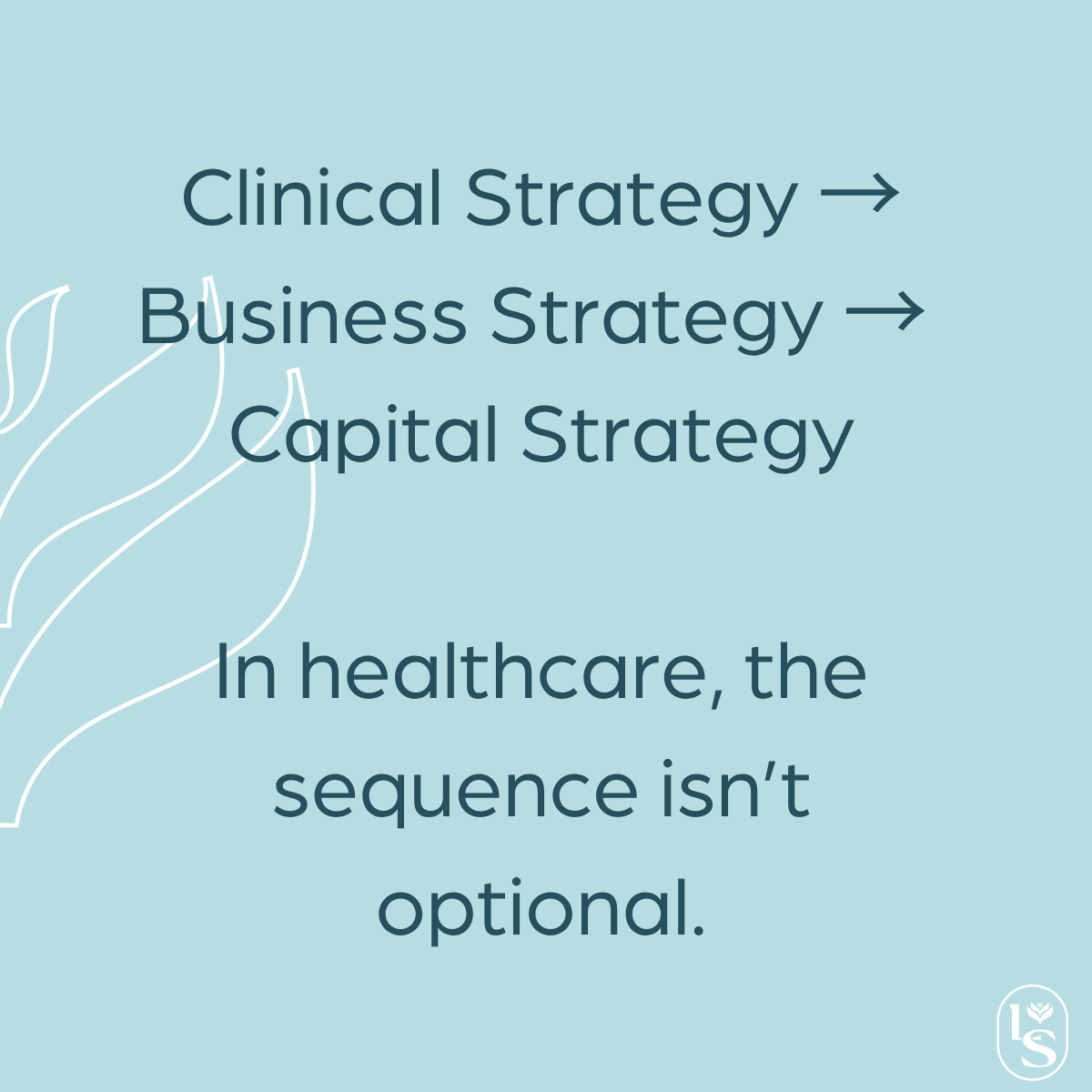
But it reminded me of something that I see often: Leaders jump to capital strategy, before grounding themselves in clinical strategy.
Here's the optimal sequence:
1️⃣ Clinical Strategy - what does excellent healthcare require? What should the patient experience be? What is important to the clinicians?
2️⃣ Business Strategy - what operating model and systems best support that clinical strategy so that care is not compromised as the company scales?
3️⃣ Capital Strategy - what capital structure would best enable the business strategy?
And yes, it is iterative. If the capital strategy doesn't work, then you revisit the clinical strategy and adjust the business strategy accordingly.
But when companies do this in reverse, shaping their clinical decisions around business constraints or investor expectations, the clinical mission slides. The patient experience suffers. Patient trust erodes.
And they stop building a healthcare company and start building a company that happens to be in healthcare.
And that distinction is more critical to the long-term sustainability of a healthcare business than most leaders realize!
December 20, 2025
Experience is essential in healthcare. The industry is full of nuance where specific expertise is critical, whether it's payor dynamics, reimbursement, HIPAA, or unique corporate structures because of CPOM. And experience often shows in how well someone can navigate these complexities to build and increase company value.
It also shapes how we listen, how we understand the challenges that patients, clinicians, and operators face and how we solve problems in a highly regulated, deeply human environment.
But experience can also become a blindfold.
Talented people become so anchored in their own experience (what their own patient journey was, what worked with their last clinic, system, or role), that they cannot absorb the experiences of the people right in front of them.
And CEOs sometimes seek advice only from those who have lived a very specific niche challenge, rather than also from those who can see the broader operational, regulatory, and strategic picture.
The result is that value isn't created as expected, patient experience suffers, and operational problems repeat themselves.
When leaders rely too heavily on their own history, or the singular history of someone else, they stop seeing the full picture.
That's when experience becomes tunnel vision.
The leaders who create real momentum and real value treat their experience as one datapoint, not the entire dataset.
They ask questions like: What am I not seeing? What does the team know that I don't? How does this workflow feel to the people actually doing it? What does the patient experience reveal that our assumptions don't?
Healthcare is too complex and too human for any one person's experience to be the source of truth.
The companies that grow, adapt, and build lasting, sustainable value are led by people who trust their own expertise while staying open to the expertise and experience of others.
The moment CEOs stop listening is the moment they stop leading.
Experience should guide us, not limit us. Of course, experience is powerful. But curiosity is transformative.
December 13, 2025
There's a bigger gap between growing a healthcare business and preparing one for a sale than most CEOs and owners expect.
Too many healthcare leaders assume that growth automatically makes a company sale-ready. In healthcare, that's rarely true.
Earlier this week, I was asked on a podcast, "When should growth become less about the founder and more about what the company is selling?"
My immediate (and honest) gut reaction was: from day one!
The clinical care, patient experience, and the solution that you deliver should be the center of gravity from the start.
Growth mode is about expansion:
🔹 More patients, more contracts, more clinical capacity
🔹 Building new service lines, developing payor relationships, strengthening referral pathways
🔹 Shortening the time it takes for new providers or geographies to become profitable
🔹 And above all, earning patient trust... and keeping it.
Sale mode, however, shifts the conversation.
Yes, of course Revenue, EBITDA, growth trajectory, diversification, and quality of care are critically important. But buyers move quickly to question... How much risk am I inheriting?
That's where the spotlight lands:
🔹 Documentation, compliance, credentialing, coding
🔹 Stability and strength of payor mix
🔹 Durability of patient retention
🔹 Repeatability of outcomes
🔹 Data to support systems
🔹 And, critically important, can this business operate without the founder driving admissions, relationships, or intake?
Clean financials and strong compliance are essential. Astute buyers will look for something deeper, systems that work without key individuals holding them together.
When healthcare leaders build for both, the growth of their mission and the transferability of their expertise, they create companies that endure for the long road.
December 4, 2025
When a healthcare business grows, its leadership, especially the CEO, needs to evolve with it.
The CEOs who thrive are the ones that evolve at the same pace as their organizations. They shift from founder to enterprise leader. They evolve from operator to strategist. They transition from being the primary problem-solver to being the culture-shaper.
Rather than staying the "doer," they are the ones that architect the conditions, clarity, and culture that allow their teams to work best at scale.
Too often, I see CEOs who were instrumental in building their companies fall out of sync with the same organizations that they created. When that happens, they get replaced. From the very companies that they may have founded or nurtured from an idea on a napkin into the impact that it's having today.
But CEOs that grow alongside their companies have learned that:
▫️ Scale requires reinvention. The skills that built the foundation of the company aren't always the same ones that allow the company to grow into its next chapter.
▫️ Clarity is the greatest asset. As the team expands, the CEOs role becomes less about answering questions and more about being the anchor for the organization's mission and strategic priorities.
▫️ CEO evolution fuels organizational growth. When the CEO evolves, the entire company feels the momentum.
▫️ Mission and Scale need to mature together. Healthcare leaders who integrate clinical mission with scalable strategy are the ones that build resilient, trusted companies.
When a business scales, its CEO must scale too. The leaders who commit to evolving themselves are the ones that stay aligned and endure through the chapters.
November 20, 2025
The trap of the sunk cost is alive and well in healthcare.
I keep speaking to healthcare CEOs that are hanging on to something, whether it is a system or a process, that they know isn't working.
It's come up 3 or 4 times just in the past week.
Yesterday, a CEO told me all about a company system that patients find frustrating. That they've been using for over a year.
When I asked why they haven't started exploring alternatives, he said "well we have already spent so many resources on it..."
I get it. It's hard to walk away from something that you've invested real resources, time, energy, and money into.
But in healthcare, your product is the patient experience. And the whole point of this business, its mission, is all about patient care.
So if the patients don't like it, that means it isn't working. And if they've been using it for over a year, it's not about ironing out kinks. If the patients don't like it, it's misaligned with their purpose.
Don't let sunk costs dictate future strategy.
Every day that you continue investing in something, whether it's a division, a system, or a workflow, you are compounding the cost, both financially and strategically.
Sustainability requires a forward-facing, long-term view. Make decisions based on what your company needs now and especially based on what it will need in the future.
So, what do your stakeholders, your patients, your clinicians, your employees, your investors... what do they need today? And what will they need next quarter? Next year? In two years?
Focus on that. That's where your investment belongs.
November 13, 2025
Over the last couple of weeks, I've spoken with several healthcare CEOs who are grappling with something familiar, the pressure to prioritize short-term gains versus the discipline of long-term decision.
It's understandable. In this world that's wired for instant gratification (I mean, a two-day delivery feels like an eternity to me), spending resources feels risky. Spending resources today impacts quarterly margins and in the short-term, feels expensive, indulgent, and like it creates financial fragility.
But the truth is, prioritizing long-term thinking is strategic and critical to business foundation.
Here are some examples in practice:
▫️ Investing in patient experience, improving patient retention and strengthening LTV/CAC ratios
▫️ Supporting clinician well-being, preventing future burnout, and reducing expensive turnover
▫️ Choosing financing paths that align incentives rather than accelerate misalignment
▫️ Hiring values-aligned team members, shaping company culture
▫️ Building communication tools to deepen patient trust and engagement
▫️ Funding clinical training to accelerate onboarding and reducing ramp-up time
▫️ Designing operational systems that enable better metrics, sharper decisions, and scalable growth
These choices might slow the pace, but they deepen the company's foundations. They drive resilient long-term results and build value.
Long-term thinking requires discipline. It requires building trust with patients, clinicians, and employees slowly, so that the trust endures. And it requires designing systems that are sustainable.
So the key question becomes, what are we optimizing for?
November 6, 2025
How many of us have seen healthcare businesses that were working beautifully?
Margins were strong. Patients felt cared for. Providers were engaged and fulfilled. The model was humming.
And then… the business started to scale. Suddenly, multiple systems were changed simultaneously. New tech platforms. New team members. New processes. All of them were necessary. All of them were strategic. And yet, the business began to fracture.
It wasn't that the priorities were wrong. These systems needed to change. They were all priorities. But the issue is that these priorities weren't sequenced.
In healthcare, where financial health and operations are deeply interwoven with the clinical workflow and patient experience, sequencing is not only a tactical detail but also a strategic imperative.
Here's an example. You're debating three major upgrades, implementing a new electronic health record, outsourcing billing, and onboarding a new telehealth provider.
Each one is a priority. But introducing all three simultaneously can overwhelm workflows, destabilize trust, and dilute accountability. The new EHR may influence which billing partner is optimal. Or the telehealth provider may integrate better with certain systems.
Sequencing these changes, so that each informs and supports the next, creates alignment instead of friction.
Or consider another example with team building. You're hiring a new finance lead, a new HR lead, and several marketing professionals.
Rather than onboarding them all at once, sequencing them allows culture to evolve intentionally. The HR leader may shape new onboarding norms that influence how the team integrates. Or the finance lead may clarify budget guardrails that shape the hiring priorities.
Each hire becomes a strategic input to the next.
Scaling doesn't mean doing everything faster. It means doing the right things in the right order for your business, your people, and your systems.
Sequence turns strategy into momentum.
The order of the operations and how you sequence and implement your changes, can be more impactful than the priorities themselves.
Even the right move can misfire if it's mistimed.
October 30, 2025
The Tortoise and the Hare still holds up, especially in healthcare.
Over the past few weeks, several CEOs have confided a familiar frustration: watching other companies seemingly surge ahead while their own progress feels slower, more deliberate.
They have mentioned examples like:
▫️ A competitor raising a $47mm round
▫️ Another expanding its social media footprint
▫️ A profile in a major publication
▫️ A sale to a PE fund for expansion
▫️ Thousands of patients served monthly
▫️ A successful Series B
Being aware of the competition is important. But let's not confuse momentum with durability.
None of these signals, fundraising, visibility, volume, guarantee staying power. The companies that endure are the ones that are relentlessly focused on the patient experience. On scaling without diluting their healthcare mission. On building systems that retain trust, not just attention.
And remember, when a healthcare business doesn't succeed, the headlines might focus on investors moving on. But the deeper cost is borne by real patients and families who placed their trust in a system that didn't deliver. Their experience is the true measure of impact and its often not very visible.
There's a cultural premium on being "first," just like the Hare's sprint. But long-term sustainability belongs to the Tortoise: the one who listens deeply, builds intentionally, and most importantly, delivers what patients actually need.
In healthcare, speed might impress. But substance actually sticks.
October 23, 2025
In every healthcare business, metrics are mirrors. They reflect performance. But they're also signals. They reveal whether strategy and scale are aligned, and whether the patient experience is quietly elevating or eroding.
Too often, companies measure what's easiest to count instead of what's meaningful. But metrics shape behavior. They define what gets rewarded, what gets repeated, and what gets remembered.
So the challenge isn't tracking metrics. The challenge is in choosing the right ones to track.
Financial metrics: margin, payor mix, days cash on hand, days in A/R. These all matter. But financials are often lagging indicators. By the time they shift, the underlying issue has already taken root.
Patient experience, clinical quality, operational efficiency, marketing effectiveness: these are leading indicators. They show what's working now and what's likely to work tomorrow.
The most effective healthcare leaders pair financial metrics with metrics that reveal:
🔹 Strategic sequencing: Are we investing in what we say we value?
🔹 Clinical mission alignment: Do our metrics reflect patient-centered care?
🔹 Operational clarity: Are we measuring what drives scalable impact?
🔹 Marketing efficiency: Are we capturing patients in ways that are both effective and sustainable?
When these metrics are tracked together, they form a connected system. Strong clinical experience metrics lead to better patient retention. Better retention improves marketing efficiency. And all of it shows up, eventually, in the financials.
Whether you're scaling a service line, refining the patient journey, or testing a new clinical strategy, the right metrics matter. For the management team. For the Board. For the clinical mission.
Because it's hard to improve what you don't measure. And sometimes, the most powerful shift is in what you choose to measure.
Metrics should provoke reflection. They should help leaders ask better questions. Otherwise, the dashboard becomes a scorecard, looking backward, not forward.
But when metrics are carefully chosen and intentionally sequenced, they become a compass. They guide. They course correct. And they remind us of what we're really trying to do!
October 16, 2025
Healthcare is local. It always has been.
Healthcare is local in delivery. But it is also local in dynamics, infrastructure, and trust.
It's a phrase that healthcare leaders often say, mid-conversation. Three words to explain why something that succeeded in one market falters in another.
Healthcare is local. So what does it mean?
Locality in healthcare shows up in many ways:
▫️ Workforce availability and staffing models
▫️ Population density, including in the nuanced in-between of urban and rural
▫️ Access to nutrition, food systems, housing, transportation, green space, safe spaces to exercise
▫️ Demographic composition and cultural landscape
▫️ Reimbursement considerations and payor mix
▫️ Broadband infrastructure and digital reach
▫️ Traffic patterns, shaped by rivers, bridges, and bottlenecks
▫️ Referral flows and legacy relationships
▫️ Social fabric, woven through history, trust, and community memory
When we speak of scale, systems, transformation, and growth, we must also speak of granularity.
Because healthcare is delivered in neighborhoods, clinics, and conversations. It's not theoretical.
What works in one community may not work in another just a few miles away.
When healthcare strategy is copy-pasted across markets, it feels like an imposition.
Healthcare strategy has to be translated with local fluency. With community trust. With operational nuance. And with respect for the lived logic of the community.
October 9, 2025
Just because someone is listening, doesn't mean they're understanding.
I've seen this play out in healthcare boardrooms, partnership meetings, and hallway conversations. A statement is made. The other person nods, responds, maybe even repeats it back. But the real message never lands.
It's as if the conversation is happening in a fog. Words are exchanged, but the meaning is obscured.
In boardrooms, this fog breeds tension, frustration, and stalled progress. The CEO and the Board both want the company to succeed, but they often walk away thinking the other "just doesn't get it" … whether the "it" is healthcare, business, patients, or strategy.
In partnerships, rapport builds over weeks or months and everyone feels aligned. Until something gets put on paper and then the misalignment becomes undeniable. And here the fog cues up exasperation and the quiet grief of wasted time, energy, and resources.
Here's what helps clear the fog:
🔹 Uncover motivations. Understanding what someone wants will help you decode what they're actually saying.
🔹 Speak plainly. You may be in the same room, but you're not coming from the same place. Ditch the lingo.
🔹 Write early. Alignment lives on paper. Draft something, react to it, refine it together.
Shared goals don't guarantee shared vision. Just because both sides want a thriving company or a partnership doesn't mean they want it to happen the same way!
You can't control the other side. But you can clarify your own. And that clarity goes a long way in cutting through the fog.
Otherwise, we are all burning time, energy, and resources. We've reached the part of the sci-fi movie where computers can think. We haven't reached the part where they can create time… yet.
October 2, 2025
Patience is a virtue. Waiting is a risk. Having the patience to see results and waiting to see results are not the same thing.
Over the last few weeks, I've been speaking with a healthcare CEO whose company is wrestling with some familiar, but compounding recurring issues:
▫️ Confusing messaging to patients
▫️ High CAC (customer acquisition cost)
▫️ Fraying internal culture
▫️ Inconsistent patient satisfaction
When I asked about next steps, the CEO said, "We're being patient." But what I heard was: Delaying. Waiting. Hoping.
Patience is active. It follows intentional change, allowing time for new direction to take root and flourish.
Waiting is passive. It defers responsibility, often cloaked in the language of virtue.
Strong leadership is not about rushing. It requires time, having the courage to move with clarity before the path is fully lit, and then holding steady long enough that the results emerge. That is patience. But waiting? It makes leadership seem unsure, tentative, and unclear.
"Patience is a virtue" ... I've been hearing this my entire life. (Usually from my parents, when I was anticipating something exciting... like ice cream.) It's true! The question is whether what you're doing is actually patience.
So, if you're a leader telling people that you're being patient, is it truly strategic stillness... or is it really waiting, which is avoidance dressed up as virtue?
September 25, 2025
This question has come up in multiple CEO conversations this week: Do we need to build this ourselves, or can we partner?
The answer loops back to the patient experience. Because that IS the product in healthcare services.
I've spent the summer making every-six-weeks visits to the ortho after injuring multiple parts of my knee. The doctor is awesome. The staff is so warm and attentive. But before each appointment, I get a text asking me to download an app to confirm. And every time, I feel the immediate friction and frustration... remember my apple password... download the app... create yet another login... all just to say yes, I'll be there!
That's not enhancing my patient experience. In fact, it is eroding it (until the lovely staff build it back up).
So when evaluating whether to build or partner, start by asking: Is this capability central to the patient experience?
If yes, will partnering give you control over quality and consistency?
If not, it may be time to start building it.
And if the capability is not core to the patient experience, then is it worth the time and investment of capital and energy to build it internally?
Or could a strategic partnership free you to focus on the core of your business?
In healthcare, the patient experience is the product. And prioritizing your strategy starts from there.
September 18, 2025
Last weekend, I looked after my neighbor's puppy, an adorable, but VERY spirited barker who was fiercely guarding his turf with so much conviction. If you've known me for years, you'd know that this was once unthinkable! I used to flinch at every bark, genuinely terrified of dogs, big or small. But living in New York, surrounded by sidewalk dogs, I eventually had to evolve.
It got me thinking about the parallels in business.
As companies scale, certain systems must evolve too, unlocking growth rather than stalling it.
I've recently spoken with CEOs of various Series C/D companies, who proudly shared systems that they've built. Despite reaching hundreds of millions of dollars of revenue, they were explaining to me that they were still scrappy and lean at heart. That they still had that founder mentality.
I'm all for being scrappy and lean. Too often, companies "fix what isn't broken," layering on corporate expense that dilutes agility.
But these CEOs were describing systems that were clearly inefficient, not to mention slowing their growth and potentially accelerating CEO burnout. And they didn't contribute to either company culture or the patient experience.
The challenge is knowing what to keep and what to evolve. Which systems are the soul and core of the company, elevate the patient experience, cultivate patient trust, and reinforce culture? And which are clunky, non-core, and quietly eroding the company's momentum?
Just like I had to evolve past my fear of dogs (well, almost), companies must evolve too, thoughtfully, strategically, and with clarity about what really drives sustainable growth.
P.S. I am SO proud to report that the puppy was well-fed and by Sunday, we'd forged a tentative friendship!
September 9, 2025
At least once a week, I have a conversation with a CEO who's neglecting their own health, while leading efforts to improve healthcare for others.
Here are a few examples:
🔹 Skipping weekly scans during a high-risk pregnancy
🔹 Two months post-ACL sprain, still no physical therapy, despite worsening symptoms
🔹 Delaying an allergist visit, even with a visibly swollen face
🔹 Running on months of sleep depravation
🔹 Canceling therapy appointments, repeatedly
🔹 Post-mammogram, postponing the recommended follow-up scan
🔹 Ignoring gut issues and putting off that colonoscopy
Each of these CEOs is DEEPLY committed to advancing care for patients. But the pattern is that they are deprioritizing their own well-being.
I've been guilty of this too. But I've learned that when I prioritize my own health, I think more clearly, lead more efficiently, and show up more fully. I suspect that many of us feel the same.
So, as we work to transform healthcare, let's not overlook the most immediate care setting, our own lives.
Let's start by prioritizing our own health.
It's a foundational strategic leadership imperative. When we lead from a place of wellness, we lead with clarity, stamina, and empathy.
Healthcare starts with us!
September 4, 2025
Is your operations team starting to show signs of burnout or turnover?
I've seen this pattern unfold too many times.
A healthcare services company earns patient trust through thoughtful clinical care and quietly effective operations. Patients feel supported. The system runs smoothly. The foundation is strong.
And then, as growth accelerates, the strain begins.
Marketing scales quickly, driven by polished messaging, ambitious targets, and flashy growth metrics. But behind the scenes, operations haven't received the same investment. So intake processes slow down, follow-ups falter, the team is stretched thin.
The systems wear down. And the patient experience begins to erode.
In healthcare services, the patient experience IS the product. And it's driven by an operations team that is responsible for the delivery of care, access, and reliability, every day.
As we grow healthcare businesses, we need to scale the systems that sustain patient experience.
Let's build them carefully so that they last.
August 26, 2025
Earlier this week, I met with a clinician-led behavioral health company whose founder identified a clear gap in the market ... and has been building a services company to address it.
What struck me the most was how seamlessly the solution aligned with the original identified gap. The founder's insight has led to shaping a company that is inspired by and rooted in a real-world challenge.
I left this meeting energized and optimistic about the future of healthcare and have been thinking about it ever since!
I often encounter companies where the founding story and the current solution feel truly disconnected.
Evolving, pivoting, and growing is part of the start-up journey.
But when sharing your founding story, it's powerful when the solution reflects the original problem. If it doesn't, that's a moment to revisit and recalibrate.
And as the company grows, periodically revisiting the core identified challenge, and ensuring that the solution is aimed at addressing it, is essential.
Let's intentionally solve for the real gaps that we are observing and for what people truly need!